CREATE YOUR LEGEND | 2026-2028 dates available | SECURE YOUR PLACE WITH JUST £100 DEPOSIT

OVERVIEW
Climbing Mount Kilimanjaro takes 5 to 9 days, but for most people the right answer is 7 to 8 days on the mountain, because altitude, not distance or fitness, decides whether you reach the summit. Here is why, what each day looks like on our 8-day Lemosho Route, and why even Kelly Halpin, who ran it in 10.5 hours, spent eight days on the mountain first.
Published by
Jack Fleckney
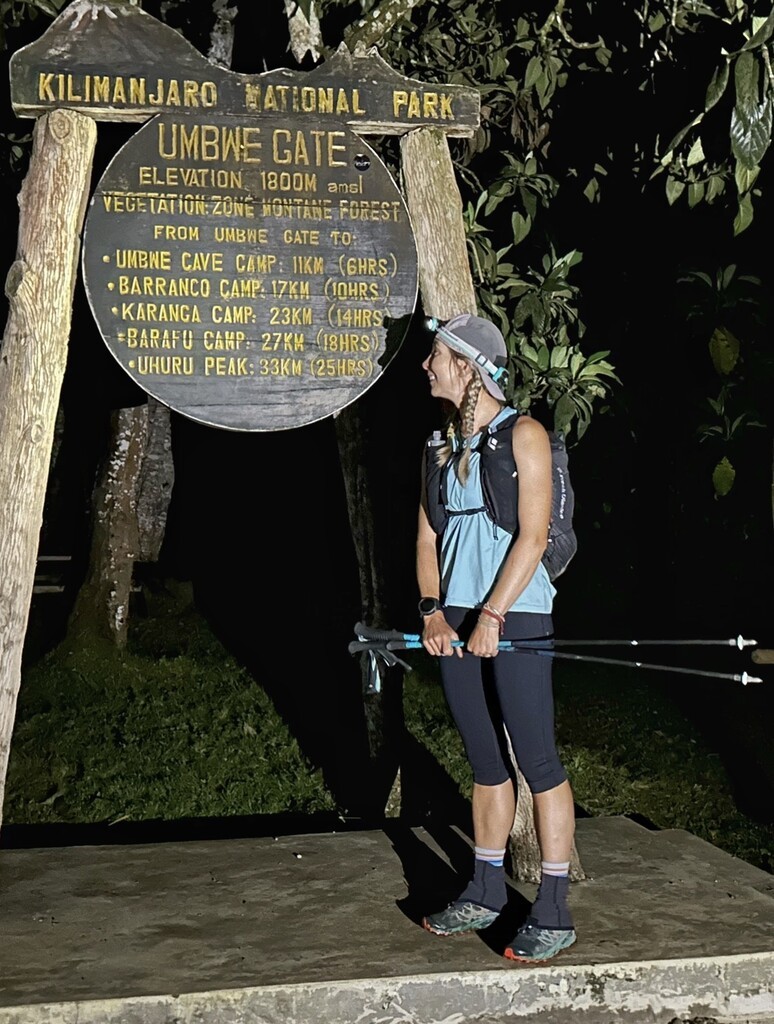
At 5am on 6 October 2026, the American mountain runner Kelly Halpin started her watch at Umbwe Gate and ran up into the misty forest on the southern side of Mount Kilimanjaro. Just over seven hours later she was standing on Uhuru Peak, 5,895 metres above sea level. By mid-afternoon she was back down at Mweka Gate, collecting high fives and hugs from her crew, having gone up and down Africa's highest mountain in 10 hours, 30 minutes and 56 seconds: the women's unsupported fastest known time.
Here's the part most people miss. Before she ran it in a day, she spent the previous eight days on the mountain.
So how long does it take to climb Kilimanjaro? For almost everyone reading this, the honest answer is 7 to 8 days on the mountain: around 6 days going up and 1 to 2 days coming down. The park allows 5- and 6-day climbs, but they shorten the one thing that decides whether you reach the top, which is time for your body to adjust to altitude. At Legend Expeditions, our group climbs run 8 days on the Lemosho Route, and that is a deliberate choice.
Halpin's run is remarkable, and the way she prepared for it tells you almost everything you need to know about Kilimanjaro. Once you see how the mountain actually works, the number of days stops being a line on a price list and becomes the most important decision you'll make.
How many days does it take to climb Kilimanjaro?
Most Kilimanjaro climbs take between 5 and 9 days, depending on the route and itinerary. The sweet spot for first-time climbers is 7 or 8 days, with the climb itself plus a night in Moshi on either side.
The shortest common options are the 5-day Marangu Route and 6-day versions of the Machame Route. At the other end, the Northern Circuit usually runs to 9 days. The Lemosho Route on Mount Kilimanjaro sits in the middle at 7 or 8 days, and its extra length isn't padding. Each day is built around getting you higher slowly, then sleeping a little lower than the highest point you reached.
The distance isn't the hard part. Daily walks between camps are typically 5 to 10 kilometres, and many days are only 3 to 5 hours of hiking. The thing that takes time is not covering ground. It's waiting for your blood to catch up with your boots.
Why does it take so long if the walking is short?
Because the limiting factor on Kilimanjaro is oxygen, not fitness. (For the full science, read our Altitude 101 guide.) At the summit, each breath carries roughly half the oxygen it does at sea level, and the body needs days, not hours, to adapt by producing more red blood cells and changing how you breathe.
Medical guidance is consistent on this. The UK's National Travel Health Network and Centre advises that above 3,000 metres you shouldn't increase your sleeping altitude by more than 500 metres a day, and should build in a rest day at the same altitude every three or four days. Kilimanjaro's summit is nearly 6,000 metres high and most routes start around 1,600 to 2,400 metres, so you can do the maths. Even a well-designed itinerary has to compress that advice, which is exactly why every extra day matters.
I learned the value of preparation in the Royal Marines, and I re-learned it in a rowing boat in the middle of the Atlantic. You cannot negotiate with physiology. You can be the strongest person in the group and still be the one with a pounding headache at Barafu Camp, because altitude doesn't care how many marathons you've run. Some of the fittest climbers I've guided have struggled most, usually because they wanted to go faster than the mountain allows.
On the trail you'll hear our guides say "pole pole", Swahili for "slowly, slowly", about a hundred times a day. It sounds like a catchphrase. It's actually the whole strategy.

How did Kelly Halpin climb Kilimanjaro in a single day?
She ran it in a day, but she didn't acclimatise in a day. Halpin spent the eight days before her run on Kilimanjaro with her guides, Simon Mtuy (a two-time former record holder) and Jackson Mtui, scouting the trails, summiting and camping up and down the mountain. By the time the clock started, her body had already done the slow work that every climber has to do.
The planning ran even deeper. She spent nine months preparing, and because park permits meant she couldn't leave in between, she camped at Umbwe Gate the night before, woke at 3:30am and set off at 5am. In her own account on FastestKnownTime, she admits she was tired from the week of scouting, and that her legs felt shredded on the descent. Even with all that time at altitude behind her, she felt some lightheadedness near the summit.
Her splits show the scale of what she did. She reached Umbwe Cave Camp in 1 hour 55 minutes, Barranco Camp in 3 hours 36, and Arrow Glacier Camp in 5 hours 7, before climbing the steep Western Breach to Uhuru Peak in about 7 hours 11. On our 8-day Lemosho itinerary, climbers reach Barranco on day five.
What I respect most is how she went about it. Park rules require a guide on the mountain, so Simon ran the same route only after she'd had a significant head start, and their paths never crossed. She calls it "not my ideal version of unsupported", but as she puts it, she was "a guest here in this country and on this mountain", and that was the best way to stay within the rules. On the way down she walked rather than ran through the crowded camps, to be polite. That evening the whole team ate ugali together at Simon's house. That's how this mountain deserves to be treated, at any speed.
So yes, speed records are thrilling, and I love watching them. But look at what sat underneath this one: eight days of acclimatisation, a heavy pack carrying warm layers, a rain jacket, first aid, a head torch, an emergency blanket and a satellite messenger, and a Tanzanian team who knew every metre of the route. Strip that away, and put someone who flew in from London or New York two days ago on the same ascent profile, and that is how people end up being carried off the mountain.
Is 6 days enough to climb Kilimanjaro, or should I do 7 or 8?
Six days can work for someone who has recently spent time above 4,000 metres (a warm-up climb of Mount Meru, at 4,566 metres, is one way to get there), but for most first-time climbers 7 or 8 days gives a noticeably better chance of reaching Uhuru Peak and enjoying the climb. If you've never been to high altitude, choose the longer option.
The difference isn't just one more night in a tent. A longer itinerary lets the route follow the "climb high, sleep low" rhythm properly. On our Lemosho climb, the best example is day five: you walk up from Shira 2 Camp at about 3,850 metres to the Lava Tower at 4,630 metres, have lunch, then drop down to sleep at Barranco Camp at around 3,960 metres. You've touched 4,600-plus metres and gone to bed only about 100 metres higher than the night before. That single day does more for your summit chances than any amount of extra training.
It's also why our summit success rate is 98.9%. I'm proud of that number, but I'm clear about where it comes from: good guides, good food, daily oxygen checks, and enough days on the mountain for bodies to adjust. On price, the extra time is a smaller cost than people expect. Our 7-day Machame climb starts at £2,846 ($3,800) and our 8-day Lemosho climb at £3,295 ($4,400), so the longer route, quieter start and extra acclimatisation day add roughly £450 ($600). Compare that with the flights, the leave from work and the months of training, and it's the cheapest insurance you'll ever buy.
What does an 8-day Lemosho climb look like, day by day?
Here's how the time actually breaks down on Legend Expeditions' 8-day Lemosho itinerary, from arriving in Moshi to flying home:
Day 1: Arrive in Moshi, kit check and briefing.
Day 2: Lemosho Gate to Mti Mkubwa Camp through rainforest (6km, 3 to 4 hours).
Day 3: Up onto the Shira Plateau to Shira 1 Camp at around 3,500m (8km, 5 to 6 hours).
Day 4: Across the plateau to Shira 2 Camp at around 3,850m (7km, 3 to 4 hours).
Day 5: Up to the Lava Tower at 4,630m, then down to Barranco Camp (10km, 6 to 7 hours).
Day 6: Over the Barranco Wall to Karanga Camp at around 3,995m (5km, 4 to 5 hours).
Day 7: Short climb to Barafu Base Camp at 4,673m, early dinner, early bed (4km, 3 to 4 hours).
Day 8: Summit night to Uhuru Peak at 5,895m, then down to Mweka Camp at about 3,100m (15km, 12 to 17 hours).
Day 9: Down through the forest to Mweka Gate and back to Moshi (10km, 3 to 5 hours).
Day 10: Fly home or carry on to safari.
Look at days six and seven. They're short on paper, and people sometimes ask why we don't merge them. The answer is that you arrive at Barafu rested, fed and acclimatised, with your energy saved for the night that actually matters. If you want the texture of those days, here's what a typical day on the mountain looks like.
How long is summit night on Kilimanjaro?
Summit night is the longest day of the climb: typically 6 to 8 hours from Barafu Camp to Uhuru Peak, then another 5 to 7 hours down to Mweka Camp. All told, you'll be moving for 12 to 17 hours.
You'll be woken around 11pm with tea and biscuits, and you'll leave camp around midnight. The first hours are a slow zig-zag in the dark, head torches strung out above and below you like a necklace on the mountain. Halpin summited in a sun hoody without ever needing her gloves, but she was running in daylight. At trekking pace in the small hours it's usually well below freezing (which is why your layering system matters so much), and the only sounds are boots on scree and people breathing hard.
Around 3am is when most people hit the wall. It's coldest, you're tired, and the top feels impossibly far away. Mindset carries you through a lot of it, but this is also where the extra days earn their keep. A climber who has acclimatised properly is tired at 3am. A climber who rushed is often sick. On a Legend climb, everyone gets one-to-one support on summit night, with a member of our support staff climbing beside them, which means someone is watching your pace, your speech and your oxygen levels the whole way up. The sun usually comes up as you reach Stella Point on the crater rim, and from there it's about an hour along the rim to Uhuru Peak.

The short answer
Climbing Kilimanjaro takes 5 to 9 days, but for most people the right answer is 7 or 8 days on the mountain, because the limit is altitude, not distance or fitness. Even Kelly Halpin, who ran it in 10 and a half hours, spent eight days on the mountain first. Everyone gets to the top the same way: by giving their body time.
If you're deciding between itineraries, I'm happy to talk it through with you. Our next 8-day Lemosho group departs on 8 January 2027, and you can check all upcoming group departures or book a call with me. And if you're starting to train, our 12-week Kilimanjaro training plan is the place to begin.
Frequently asked questions
Can you climb Kilimanjaro in 5 days?
Yes, the Marangu Route can be climbed in 5 days, but it's the itinerary with the least time to acclimatise and isn't one we recommend for first-time high-altitude climbers. A 5-day climb means gaining well over 4,000 metres of altitude in four days of ascent, faster than medical guidance on safe ascent rates suggests. If you're short on time, 7 days is a much safer minimum.
How many hours a day do you hike on Kilimanjaro?
On most days you'll hike for 3 to 7 hours, covering roughly 4 to 10 kilometres at a deliberately slow pace. The exception is summit night, when you can be on your feet for 12 to 17 hours including the descent. Afternoons are usually spent resting, eating and acclimatising in camp.
How long does it take to come down Kilimanjaro?
The descent usually takes about a day and a half. After reaching Uhuru Peak you descend to a lower camp, such as Mweka Camp at about 3,100 metres, that same day, then walk out through the rainforest to Mweka Gate the next morning. Going down is much faster than going up because you no longer need to acclimatise.
What is the best number of days to climb Kilimanjaro?
For most climbers, 7 or 8 days on the mountain is the best balance of acclimatisation, cost and time away. Longer itineraries give your body more time to adapt to altitude, which improves both your chances of summiting and how you feel on the way. An 8-day Lemosho Route is a strong choice for first-timers.
How long is the whole Kilimanjaro trip including travel?
Plan on 10 days door to door for an 8-day climb, including a night in Moshi before and after, and longer if you're flying from Europe or North America with connections. Many climbers add a 2 to 4 day safari afterwards, which makes a two-week trip. Moshi is about an hour from Kilimanjaro International Airport, and our guide to flights to Tanzania covers the best options.