OVERVIEW
On a guided Kilimanjaro climb with Legend, about six crew look after every climber. Jack Fleckney explains who is in the team, what the lead guide does all day, how guides are chosen and trained, and what to ask any operator about its guides before you book.
Published by
Jack Fleckney
When people ask me what a guided Kilimanjaro climb actually involves, they usually picture one person with a map walking at the front. The reality is a crew of about six people for every climber, led by a lead guide whose job is mostly logistics and safety: watching everyone, keeping to the timings, checking your health every morning and giving you the best possible chance of reaching the summit. For a group of eight, that can mean around 48 people on the mountain with you.
This post walks through who those people are, what the lead guide does from first light to the evening briefing, how we choose and train our guides at Legend Expeditions, and the questions worth asking any operator about its guides before you book.
Who is on the team for a guided Kilimanjaro climb?
On average we run a ratio of about six crew to every climber. That’s the average, remember, not a fixed rule. Some kit goes up the mountain however many climbers there are: the cooking equipment, the mess tent and the sleeping tents for the crew. That baseline needs porters to carry it, so the smaller the group, the higher the ratio. The rest scales with each client.
Inside that number you’ve got a lead guide, assistant guides, a cook and then porters carrying everything else. For a group of eight, we’re looking at potentially 48 staff climbing with those eight people, all of them there to look after you and get you to the top. If you’re weighing up joining a group against going on your own, our guide to private versus group Kilimanjaro climbs explains how the team changes.

Your guides start before the mountain does. The lead guide meets you the day before the climb, and the guides collect you from the hotel on the morning you leave. The rest of the team go ahead on separate buses to get through the check-in process at the gate. That matters more than it sounds: at a busy gate you can easily wait a few hours for checks, and doing it this way removes most of that wait.
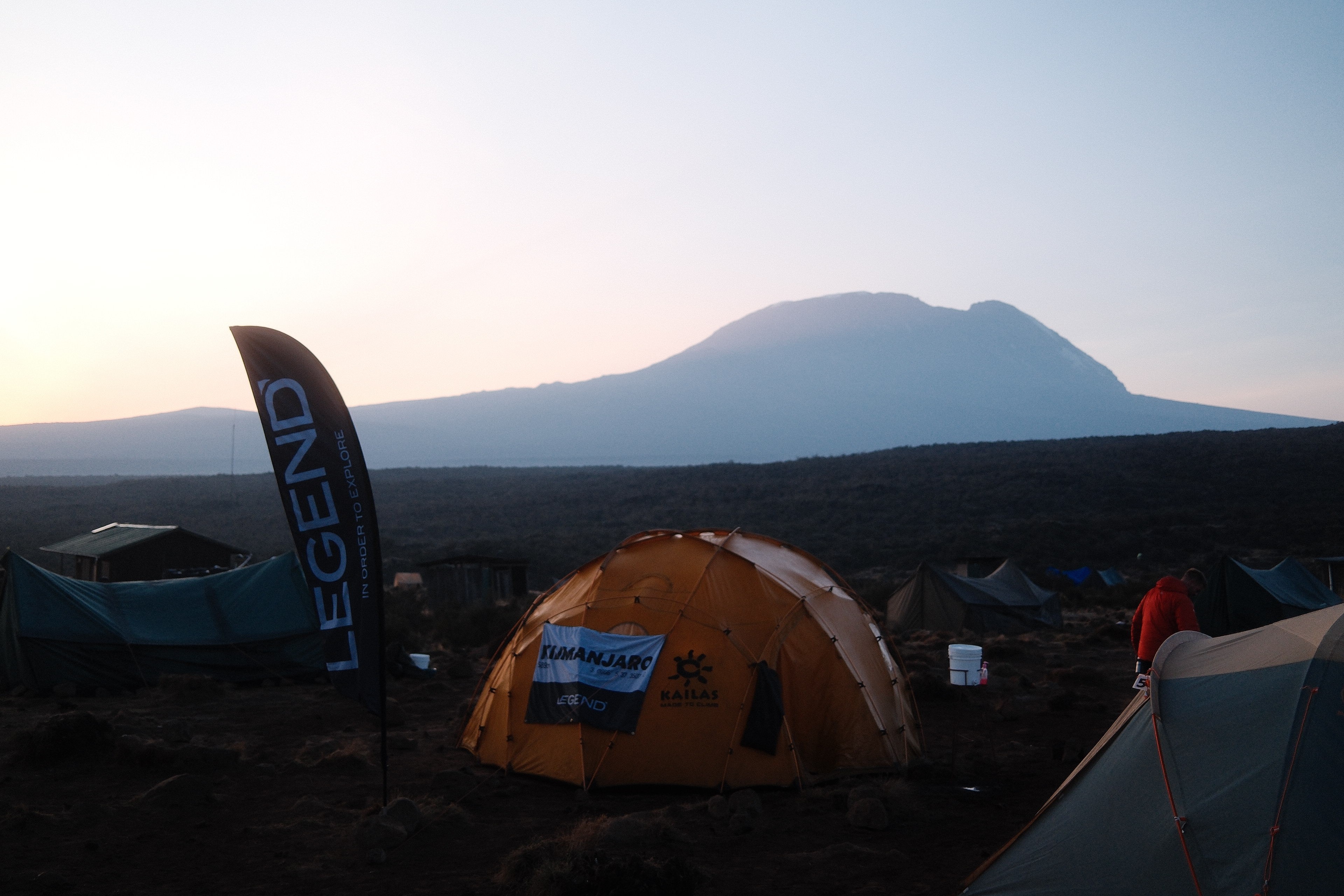
By the time you arrive, the crew have usually finished checking in and they’re there to greet you with singing and dancing. With that many people there won’t be formal introductions, but every one of them will know your name. Then you start walking, and the crew head off ahead of you to have the first camp up and ready when you get there.
What does a Kilimanjaro lead guide actually do all day?
A lead guide’s job is a big logistical role and a big safety role. They stand back and watch everything. They make sure the whole team is doing well, that camp is being sorted and the crew are moving well. They lead the assistant guides, keep safety as the priority, keep to the timings and make sure every climber is happy, content and coping.
A typical morning runs like this. Wake-up is usually around 6am, and the guides wake at about the same time as you. Breakfast is at 7am, and while you’re eating in the mess tent, warm, the lead guide and assistant guides come in and do your medical checks. They check your oxygen saturation and resting heart rate and go through a form you fill in about how you’re feeling. They score it, report the results to our HQ at the bottom of the mountain, then give you a quick brief: here’s the plan, here’s when we leave. Walking starts around 8am.

Those morning numbers are the quiet backbone of the climb. Altitude problems rarely come out of nowhere; they usually show up as a trend, and a lead guide reading that trend every day is how small issues get dealt with while they are still small. If you want the medical side in more depth, our guide to altitude sickness on Kilimanjaro explains what the symptoms look like.
How do Kilimanjaro guides spot when a climber is struggling?
Our guides are extremely good at spotting when someone is starting to struggle a little, whether that’s a change in mood, a change in pace or just energy levels dropping. Rather than one dramatic story, it’s more useful to describe what they actually tend to do, because some version of it happens on most climbs.
The first move is usually simple: take the backpack off that person and start chatting with them to help them through the day. Sometimes it’s taking a slightly shorter line on the trail. Sometimes it’s the lead guide saying, let’s leave a little earlier tomorrow morning, so this person has more time and doesn’t have to rush to reach camp. There are lots of small calls like that, and together they make the difference.
Where the guides really stack up is when people are at their most tired. On summit night, if you’re exhausted, your guide will be right by your side, already carrying your backpack, holding your hand all the way to the top, singing and keeping you moving. On the descent they’ll put an arm around you to take some of the weight off your legs, and stay next to you all the way down to the gate. That’s the part climbers talk about afterwards. When everyone is tired it would be easy to just drift along, and our guides don’t. There’s more on that night in how 98.9% of our climbers reach the top.
How does Legend choose and train its Kilimanjaro guides?
We choose our guides on personality first. Our line is that we’re looking for people with a good heart who are good team members. You can have a guide who is brilliant with clients but doesn’t work as part of a team, and on the mountain the team is the most important thing. We’re trying to build a family of people who all work together: selfless, cheerful and there for everybody else.

To lead for Legend, we look for that extra bit of detail that is often missed on Kilimanjaro: noticing the small things and driving the highest standards on the mountain. Every new guide goes through our own Legend training and gets the Legend training booklet, written in English and Swahili, so they have a real understanding of what we expect.
We’re happy to hire new guides with less experience, but they come in as assistant guides. Someone might join having summited 10 to 20 times; they’ll support and learn the trade with us, and it often takes a year or two of climbing with us before they get close to leading their own trips. Lead guides need a lot of experience and must be Wilderness First Responder trained. Over 100 ascents is the norm for a Legend lead guide, some have done over 200, and Jackson, our co-founder, has done over 300. You can meet some of them on our team page.
It doesn’t stop once someone is hired. We assess how the guides perform on every single climb, through the quality of the trip and the feedback, and our core leadership team is monitoring that all the time.
Are all Kilimanjaro guides the same, and what should you ask before you book?
No. The most common mistake people make is assuming every licensed guide is the same. Pay scales between companies are hugely different, and that changes both the quality of the work guides deliver and their motivation to do it. You want a team that is really happy, and a big part of being happy is knowing you’ll be paid on time. One of the things you see on the mountain is crew doing their job and then waiting a long time before they actually receive their money.
So the first question I’d ask any operator is whether they’re a KPAP partner. KPAP is the Kilimanjaro Porters Assistance Project, and there aren’t a huge number of partner companies operating in Tanzania. Being one guarantees the company at least holds the minimum standards for how its crew are looked after: the right amount of food, the sleeping situation, equipment, pay and how much weight each person has to carry. Our guide on how to choose a Kilimanjaro company has the full list of questions.
The next good question is how many crew will be on the mountain with you. The catch is that anyone can give you an answer, and you won’t know whether it’s true until you’re there. Sometimes fewer people turn up than were promised. Sometimes an operator claims more crew than it really has, so it can ask for more tip money.
Which brings me to tipping. We give a flat recommended tip rate per climber that is shared across the whole team. Some companies ask you to tip per guide, per porter and per staff member, and that is exactly where inflated crew numbers start to pay off for the wrong people. If an operator’s tipping guidance is a long per-person list, ask how many of those people will actually be walking with you. Our honest guide to tipping on Kilimanjaro explains how ours works.
What does Legend do differently for its guides and crew?
Pay comes first. We pay the team a higher level than the minimum, and I’m really proud that we’ve increased it as we’ve grown. Everyone is paid the day they come off the mountain, with no delay.
Loads come next. Weight is shared out properly across the team, so nobody is carrying a huge amount, and the crew support each other through the climb so everyone gets to camp safely. Every load is weighed at the gate and kept under 20 kg, and if a bag is too heavy we hire another porter. There’s more detail on our porter welfare page.

Tips are handled in the open. They’re collected from climbers at the hotel when you get back after the climb, then shared out equally to the team at our office, with a KPAP auditor there to oversee it. Nobody quietly takes a bigger share.
Then there are the basics that make a long week on the mountain manageable for the people carrying it: proper sleeping arrangements, plenty of calories so nobody goes hungry, and the right kit. We run our own rental store at the office, and the whole crew can borrow from it for free: boots, jackets, hats, gloves and head torches. Climbers can use the same store through our Kilimanjaro kit hire. A crew that is warm, fed and paid fairly is a crew with the energy to hold your hand at 3am.
The short answer
A guided Kilimanjaro climb with Legend means about six crew for every climber, led by an experienced, WFR-trained lead guide who checks your health every morning, keeps the whole operation running and stays by your side when it gets hard. The quality of that team depends on how they are chosen, trained, paid and looked after, so ask any operator about all four before you book.
If you’d like to meet the team that would walk out of the gate with you, book a call with me and I’ll talk you through it, or have a look at our group climb dates. If you’re still choosing a route, our Lemosho Route is a good place to start, and plenty of climbers finish with a few days on safari.
Frequently asked questions
Do you need a guide to climb Kilimanjaro?
Yes. Kilimanjaro National Park requires every climber to go with a licensed guide through a registered operator, so you can’t climb independently. The real choice is which operator, and how well its guides are trained, paid and supported.
How many guides and porters do you need for Kilimanjaro?
At Legend we average about six crew per climber, made up of a lead guide, assistant guides, a cook and porters. Smaller groups need proportionally more, because kit such as the mess tent, cooking equipment and crew tents goes up whatever the group size. A group of eight might have around 48 crew.
What qualifications should a Kilimanjaro guide have?
Every guide must hold a park licence, but that’s the minimum. Legend lead guides are Wilderness First Responder trained and typically have over 100 ascents, and new guides spend a year or two as assistant guides before they lead their own climbs.
How should tips for Kilimanjaro guides and porters work?
Look for a flat recommended amount per climber that is pooled and shared equally across the whole crew, ideally with KPAP overseeing it. Be wary of long per-person tipping lists, which can encourage operators to overstate how many crew are on the mountain.